
POMOS - Household Power Monitoring System
A prototype exploring how household-level electrical telemetry can give Zambian utilities earlier, clearer evidence of low-voltage faults and improve the path from detection to field response.
The gap at the customer endpoint
POMOS began with a practical question about residential power faults: what can a utility know before a customer calls? A resident experiences low voltage or an outage immediately, while an operator may initially receive only a description through a call centre, USSD report or online ticket. That report matters, but it may lack measured voltage, current, phase and location context. POMOS explores endpoint telemetry as an additional evidence stream.
The system I designed
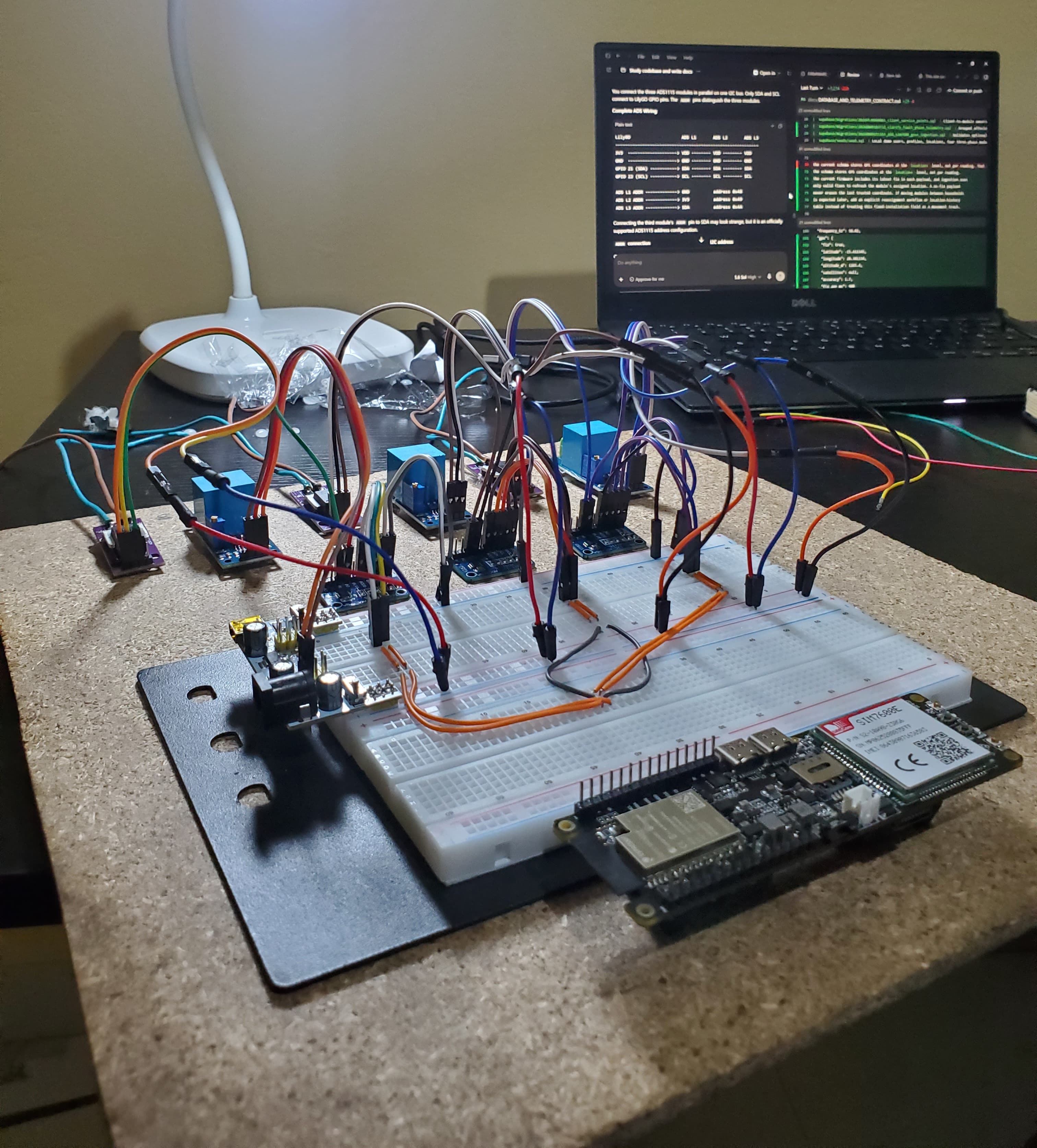
The prototype combines sensing, embedded processing, cellular transport and an operator-facing application. Voltage and current sensing feed an ADS1115 analogue-to-digital stage and an ESP32-based controller. The firmware calculates RMS values and packages telemetry with device and location context for transmission over a SIM7600 cellular module. On the server side, PostgreSQL-backed records and fault evaluation support dashboard, map and technician workflows. This design joins electrical engineering, telecommunications and software instead of treating fault detection as a dashboard-only task.
The operator view is intended to show where abnormal readings originated, what was observed, how an event was classified and what follow-up occurred. Role-based access and an audit trail matter because a utility decision should remain reviewable. Household measurements would complement customer reports and protection systems; they cannot, by themselves, locate every network fault or replace field diagnosis.
What has been demonstrated
The application, database migrations, role-based workflows and automated telemetry checks have been exercised locally. Firmware builds and a device-to-backend path have also been demonstrated. The physical sensing chain still needs calibrated voltage and current measurements, multi-channel validation, input-safety proof, an enclosure and controlled field trials. Those steps determine whether the system can make reliable claims about real household faults. POMOS is therefore an engineering prototype, not a finished utility deployment.
The public description intentionally omits private device credentials, utility records and raw internal project documents. Read When the last mile goes dark for the wider problem and the operational value this evidence could provide.
The residential problem
When a low-voltage fault occurs, the first operational signal may be a resident's call, USSD report or portal ticket. That report is necessary, but it rarely includes measured voltage, current, affected phase or reliable coordinates. POMOS investigates how endpoint telemetry can add that missing evidence.
The engineering question
Can a practical monitoring node safely measure household electrical conditions, calculate useful RMS values, identify abnormal patterns, attach location context and move the evidence through a cellular network into an operator workflow? The project treats this as a connected power, electronics, telecoms and software problem.
Utility capability
The intended value is earlier situational awareness, clearer prioritisation, map-based dispatch, fewer duplicate interpretations of one network event and an auditable maintenance history. Telemetry supports the operator; it does not remove the need for customer reports, protection systems or technician judgement.
Current evidence and limits
The dashboard, database migrations, role-based workflows and automated telemetry checks have been implemented and locally exercised. Firmware builds and device-to-backend transport have also been demonstrated. Physical multi-channel sensing, calibration, enclosure design and controlled field validation remain active prototype work.