
When the last mile goes dark: improving residential power fault visibility in Zambia
2026-08-21
Why customer complaints alone cannot provide complete visibility of low-voltage faults, and how household telemetry can strengthen detection, dispatch and maintenance without replacing people or protection systems.
The gap
Residents feel a low-voltage fault before an operator necessarily has measured evidence from that endpoint. Calls, USSD reports and portals are important, but descriptions alone do not reveal the voltage, current, phase condition or exact location.
The engineering response
POMOS combines electrical measurement, instrumentation, embedded processing, cellular communications, geospatial context, database engineering and an operator workflow. The important output is not a gadget; it is reliable operational evidence.
The utility value
A utility could use structured endpoint telemetry to see abnormal conditions earlier, group related events, prioritise dispatch, locate the affected area and preserve a consistent record from detection through resolution.
The honest boundary
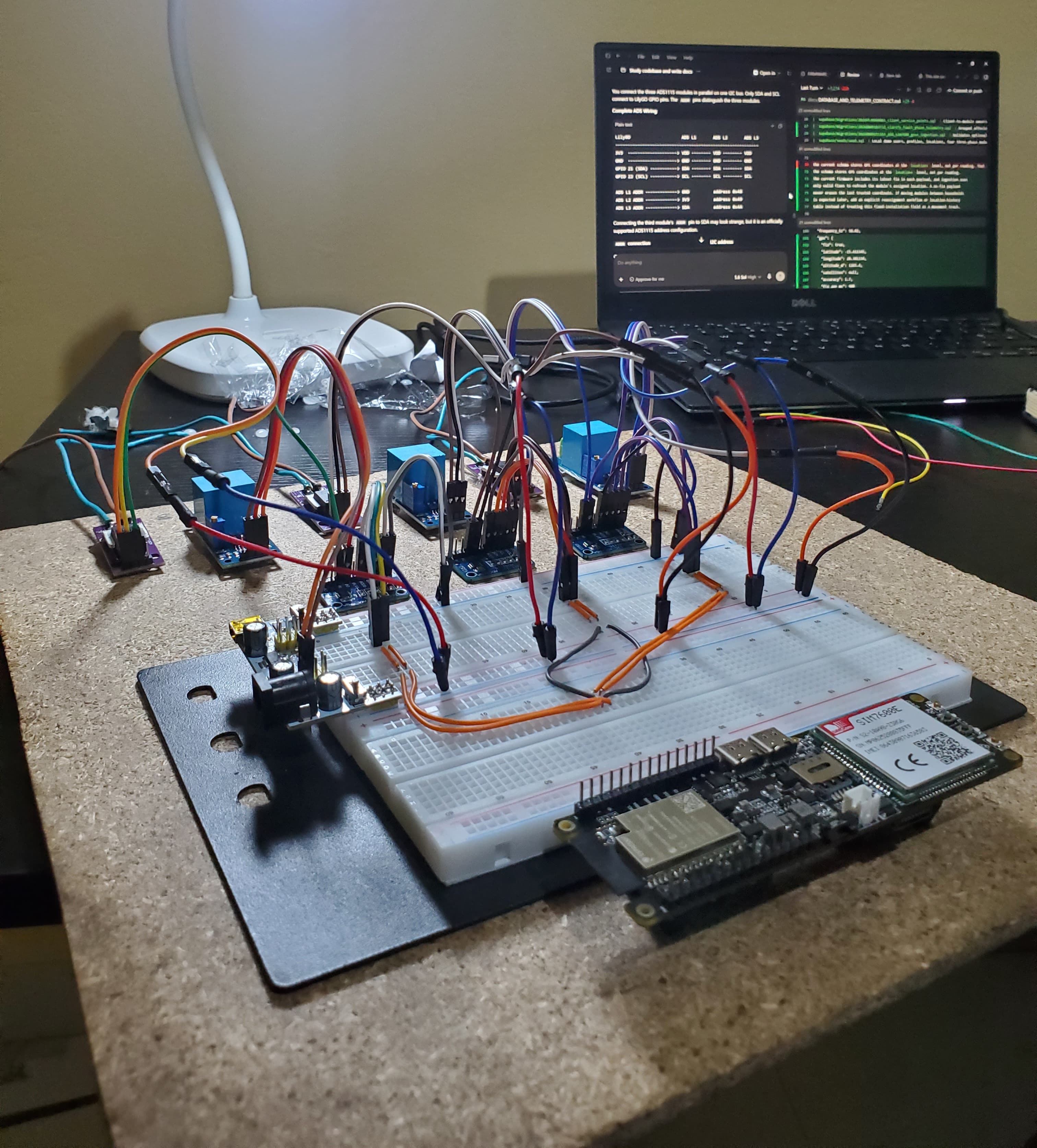
The project has implemented and locally tested major software, database and telemetry foundations. Physical sensing, calibration and controlled field validation remain prototype work, so the article describes intended capabilities rather than claimed national outcomes.
Electricity faults are experienced locally. A light dims in a home, a refrigerator stops, a router drops offline or several houses on one street lose supply. At that moment, the people affected already know that something is wrong. The utility may not yet know what has happened, how severe it is, how many customers share the same cause or exactly where a field team should begin looking.
That difference between experiencing a fault and having operational evidence of a fault is the problem behind the Household Power Monitoring System, or POMOS.
POMOS is not mainly an attempt to sell another connected device. It is an engineering investigation into how better evidence at the residential edge of the network could help a utility move from an incomplete description of a problem to a measured, located and auditable event.
Zambia already has ways to report faults
ZESCO operates a 24-hour call centre and provides digital channels, including a mobile application, USSD and a customer portal. These channels are essential because they give residents a direct path to the utility. ZESCO describes fault management as one of the responsibilities supported by its customer-service systems on its distribution and customer service page.
The limitation is not that complaints have no value. The limitation is that a complaint is usually a human observation rather than an electrical measurement.
A resident can accurately say, “our power is low,” “the lights are flickering,” or “the whole street is off.” But the report may not answer the questions an operator needs next:
- What voltage was present, and for how long?
- Was current unusually high before the interruption?
- Is one phase affected, or is the whole local supply unavailable?
- Are nearby households reporting the same electrical pattern?
- Is the event still active when a technician is dispatched?
- What is the precise service-point location?
The complaint channel begins a conversation. It does not automatically create a complete diagnosis.
Why the last mile matters to residents
For a household, reliability is not an abstract system index. It is the ability to keep food cold, charge a phone, study after sunset, operate a small business, connect to the internet and use appliances without damaging them through poor voltage conditions.
A World Bank household energy-access diagnostic, based on earlier survey evidence, found that roughly one-third of grid-connected Zambian households experienced frequent, unpredictable interruptions. It also recorded households reporting low or fluctuating voltage and associated appliance damage. The figures are historical rather than a measurement of conditions in 2026, but they show why power quality and reliability must be understood at household level, not only at generation and transmission level.
Recent system-level reporting shows that Zambia is continuing to strengthen power-quality monitoring. The Energy Regulation Board's 2025 Energy Sector Report records 48 major system disturbances during 2025 and reports that 89 percent of required monitoring locations across the interconnected power system had power-quality recorders installed. For ZESCO, 126 of 161 target locations had sufficient data for reporting.
Those recorders are important infrastructure. POMOS asks a different, complementary question: what useful operational detail could be gained closer to the residential endpoint? A system can have strong monitoring at major interconnection points and still benefit from clearer evidence about conditions experienced on a particular low-voltage feeder, phase or service area.
The real engineering product is evidence
It is easy to describe POMOS as an Internet of Things project because it contains sensors, a microcontroller and cellular communication. That description is technically correct, but too shallow. The project joins several engineering disciplines because no single layer can make the evidence trustworthy on its own.
Power systems engineering defines what matters
The first task is to translate a resident's experience into electrical quantities. POMOS focuses on RMS voltage and current, along with conditions such as undervoltage, overvoltage, overload, phase loss and imbalance.
These quantities matter because different symptoms can point to different operational problems. A complete outage, a sustained low-voltage condition and an overloaded circuit should not enter the same queue as if they were identical. Deterministic thresholds provide a consistent first classification, while the final interpretation remains an engineering and operational responsibility.
Electronics and instrumentation determine whether the measurement can be trusted
Household mains cannot be connected directly to a microcontroller. Voltage and current have to be transduced, isolated or safely conditioned, shifted into the input range of the analogue-to-digital converter, sampled and calibrated against a known reference.
POMOS uses a voltage transducer, Hall-effect current sensing and a higher-resolution ADC as part of this measurement chain. The important engineering work is not the component list. It is controlling error, noise, clipping, bias, grounding and calibration so that a number sent to the database represents the electrical condition rather than a wiring or signal-conditioning fault.
Embedded systems turn waveforms into useful telemetry
An embedded controller samples the conditioned signals and calculates RMS values over a defined window. It also has to manage device identity, timestamps, phase labels, health information and communication state.
This is where resource-aware engineering matters. The node must collect enough information to be useful without overwhelming the network or database with unnecessary traffic. It should distinguish routine heartbeat data from events that deserve immediate attention, while preserving enough context for later analysis.
Telecommunications engineering moves the evidence beyond the house
Residential monitoring is only operationally valuable if the data can reach the utility. Cellular communication is relevant in Zambia because it does not assume that every monitored location has fixed broadband. The communications layer has to manage device authentication, packet structure, network interruptions and transport over standard internet protocols.
Coverage is not the same as guaranteed delivery, so resilience has to be designed and tested. Failed transmissions, reconnection behaviour and delayed data are engineering conditions, not edge cases to ignore.
Geospatial engineering connects detection to dispatch
A fault ticket without a useful location can still consume technician time. Coordinates and service-point records can connect an electrical event to a map, a feeder area, a transformer group or a navigable field destination.
Location does not replace network diagrams or asset identifiers. It improves the handoff between what the system detected and where a technician should investigate.
Software and database engineering turn readings into an operational record
Raw readings are not yet a maintenance workflow. POMOS uses a relational data model to connect modules, locations, reading batches, phase measurements, faults, assignments and resolutions. Database functions evaluate telemetry against configured thresholds and preserve the evidence associated with an automatically detected event.
The dashboard then gives different users an appropriate view: administrators need network-wide awareness and assignment controls; technicians need the fault evidence, location and work status; clients need a truthful distinction between a measured event and a manually reported concern.
This distinction is important. A customer's report should not be given a fabricated voltage or threshold merely to make it resemble an automatic sensor event. Good engineering preserves the origin and confidence of the evidence.
What changes for a utility?
If endpoint telemetry is reliable and deployed responsibly, it can strengthen several utility capabilities.
Earlier situational awareness. The operator can receive an abnormal measurement without waiting for a large number of customers to report the same symptom.
Consistent prioritisation. Measured values, affected phases, duration and severity give dispatch staff a repeatable basis for triage. Customer safety reports and technician judgement still take precedence where appropriate.
Event grouping. Several nearby nodes showing a similar pattern can be examined as evidence of one upstream event instead of being treated only as unrelated tickets.
Better field dispatch. Coordinates, asset relationships and recent measurements reduce the amount of location-finding and preliminary diagnosis required before work can begin.
Auditable response. Detection time, assignment, arrival, action and resolution can be stored as separate events. That creates more reliable response metrics than a single manually edited status field.
Maintenance planning. Repeated undervoltage, overload or imbalance patterns can identify areas that deserve inspection before a larger failure occurs. Predictive claims should only come later, after enough clean field data exists.
The result is not the elimination of people from fault management. It is a better information environment for the people already responsible for it.
What POMOS has demonstrated, and what remains
The project's software and database foundations are implemented. The current system includes role-based web workflows, phase-aware telemetry structures, automatic threshold evaluation, map-based context and local smoke tests for representative ingestion and fault scenarios. Firmware builds and device-to-backend communication have also been demonstrated.
The physical prototype is still under engineering validation. Multi-channel sensing paths require continued bench diagnosis, calibration against reference instruments, safety review, enclosure development and controlled end-to-end testing. A successful firmware build or HTTP response does not prove measurement accuracy, electrical safety, field reliability or utility-scale impact.
That boundary matters. POMOS can already demonstrate a coherent architecture and working parts of the telemetry workflow. It cannot yet honestly claim that it has reduced national outage duration, prevented transformer failures or delivered production-scale utility savings. Those outcomes require field trials, baseline measurements and collaboration with the relevant utility and regulator.
A better way to frame the project
The strongest case for POMOS is not “this device will solve Zambia's electricity problems.” Zambia's power system is too large, and its reliability challenges are too varied, for that claim.
The stronger and more defensible proposition is this:
When a residential fault occurs, utilities make better decisions when customer reports are complemented by timely, measured, located and auditable electrical evidence.
POMOS is Joseph Kapembwa Sichula's engineering exploration of how to produce that evidence with a practical combination of power systems, electronics, embedded computing, telecommunications, geospatial data and software operations.
The project is therefore about visibility before it is about hardware. It is about helping the utility see the last mile more clearly, helping technicians act with better context and helping residents move from repeatedly describing a problem to being represented by reliable data.
Explore the POMOS project case study for the architecture, current implementation evidence and remaining validation work.